Wednesday, June 29, 2011

Spain After Franco and the Role of the Monarchy

Francisco Franco ruled Spain from the year 1939 until his death in November 1975 as “Caudillo by the Grace of God”. He was the chief of state and head of government, which was the ultimate source of authority. During his thirty-six years as dictator, Franco’s dictatorial regime remained unchanged in its most basic principles: the concentration of power in the hands of Franco and the absence of a constitution and of freedom of democratic parties and rights. 

After Franco’s death, Spain began its gradual, and very slow transition into democracy with the proclamation of Juan Carlos I as King of Spain on November 22, 1975. During his speech, he openly expressed his position in favor of the establishment of democracy in Spain in order to overcome the division of its people as a result of the Civil War. As prince of Spain, Juan Carlos I, aware of the crumbling state of the regime, and knowing that in order to consolidate the monarchy of Spain there needed to be a social and political consensus, had already established some very important relationships with influential politicians. Consequently, Juan Carlos I faced having to deal with the democratic opposition, which led to the replacement of Arias Navarro by Adolfo Suarez, who took over as Prime Minister in July 1976. 

The Constitution was drafted by a commission composed of seven members of the main groups represented in the House. After some amendments and a vote by members of Congress and the Senate, the Constitution was adopted on December 6, 1978. The result of the long constitutional debate was conditioned by the limits set by the Political Reform Act, and positions taken on some issues by certain sectors of the military and the Church. Nationalists, who included Convergencia i Unio (Catalonia) and Partido Nacionalista Vasco (Basque Country) also participated in the drafting of the Constitution. The consensus reached was focused on respect for the economic market, state planning board, and national unity within a state divided into autonomous regions.
It is clear that the Constitution of 1978 represented the formal restoration of democracy in Spain, and because of the wide support of Parliament and the people of Spain, there was a huge change in the political history of the last two centuries.
The stability of Spanish democracy has also benefited from unconditional support of the Crown. In the restoration of the monarchy in Spain, King Juan Carlos I has shown intelligence and wisdom, to the point of placing the reputation of the monarchy in the highest level of the modern history of Spain. Several factors including the royal family’s open and fairly simple lifestyle, and their support to numerous humanitarian and moral causes have thus placed the Royal Crown above politcal and ideological confrontations and therefore become the final guarantee that Spain will maintain its current democratic values and institutions. 

Sunday, June 12, 2011

Lagos, Portugal...LOVE!!

We spent an amazing weekend in Lagos!!! We were definitely a bit hesitant about going in the first place because a lot of us wanted to go to Morocco or somewhere else like Barcelona or Ibiza but I think the moment the guys from Discover Sevilla walked into our classroom we decided it was best to just go with it and join them in Lagos. What a great idea...we ate great food, we surfed-- or at least TRIED to surf, and we chilled....no homework, no walking, no cathedrals...just the beach and great times with amazing friends.


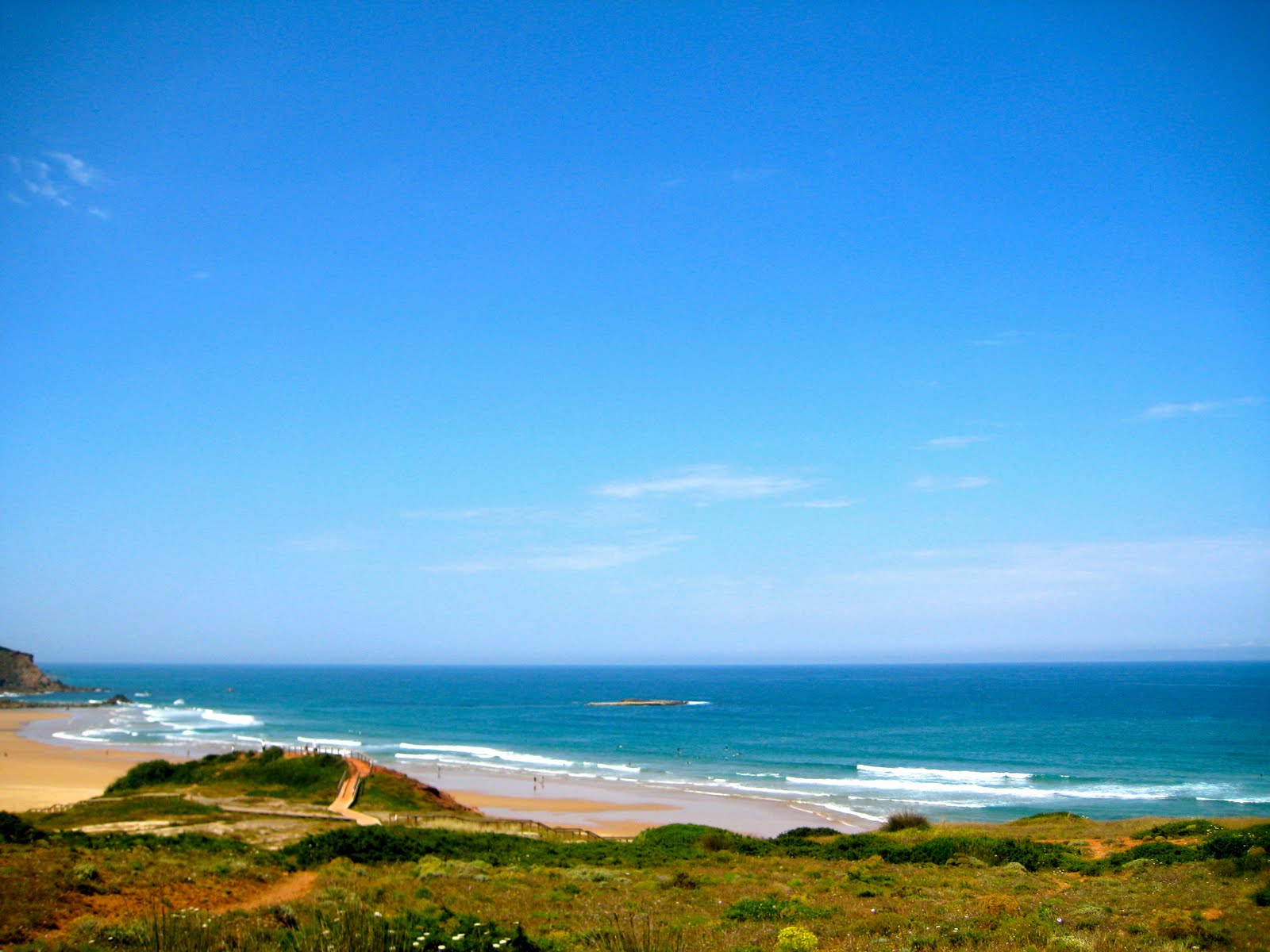
The view from out hotel was amazing. There was a beach with gigantic rocks like the one I'm standing on above. The sand was a beautiful, almost golden color and very rough. We all gave our feet a much-deserved facial...or foot-cial.

The water was absolutely freezing. So much so, that we had to wear wetsuits while trying to learn to surf, but our surf lesson was so much fun and totally worth freezing our butts off!!!


The best part of the trip was by far the sunset they took us to see. This place was thought to be the end of the world back in the day. It is absolutely breathtaking. The colors and the sheer grandeur of the cliffs is spectacular. I think I got the some of the best photos of my entire trip here in Portugal....enjoy!


Beautiful sunset...
 With Christie...

 and Caressa....

 and Christy....


Don't be fooled by my happy face...I was miserable on the way back up...


Finally tan!

This is where we learned to surf....back off South Beach...you don't stand a chance....
 

Saturday, June 11, 2011

Visit to the Prado Museum


The Prado Museum is a must-see for art lovers and connoisseurs in the city of Madrid. Being an art enthusiast really makes the experience much more enjoyable. It involves a lot of walking, stopping, staring and really taking in the art.
While I enjoyed most of the art, we took a deeper look at Andalusian painters and the following three were my favorites:
 
“Las Meninas”   
Diego Velรกzquez, born in Sevilla in 1599, was probably one of the most incredible painters of his time.          

This painting, also known as “The Family of Philip IV” was truly breathtaking in person. This piece is actually one of the paintings that I studied all throughout school in art appreciation classes and seeing it in real life was quite a treat. When you see it up close you can really take in all the details and it’s really interesting to see the different techniques used by the artist. The main focus of this painting is the little girl in the light colored dress, who is the Infanta Margarita. She is being attended to by two meninas; Maria Agustina Sarmiento de Soto Mayor, who is kneeling and Isabel de Velasco who is curtsying. 
The way this scene was captured seems almost without warning because several figures in the piece don’t seem to be posing or are shown looking away or interacting with one another. To the bottom right of the painting there is a dwarf whose face is seemingly blurred out and small child nudging the dog with his foot. These characters faces are both blurred and lack detail in their faces.
The man holding the brush and palette is Diego Velazquez himself looking outward past the easel and I’m assuming there is a huge mirror in front of this entire scene. In the background one can also see a man standing by the doorway; he is Don Jose Nieto Velazquez and he is not rendered with much detail. Closer to the foreground is a woman who is the princesses’ chaperone and she is standing next to a man who is also blurred and not really identifiable. 
 _______________________________________________________________


“Agnus Dei” 
Francisco de Zurbaran was born in Fuente de Cantos in 1598 and was known mainly for his religious pieces.

While this painting is probably one of the least intricate, it’s the one I liked the most. Its simplicity is what caught my eye. The subject is the absolute main focus of the piece and there is nothing else to distract you from it because the black background gives no reference to space. I love the detail of the sheep’s wool and how realistic the animal looks. This painting conveys a feeling of peace despite the fact that the sheep is tied up and probably dead. “Agnus Dei” means Lamb of God so this piece obviously has a religious meaning.
 ______________________________________________________________


“Cristo Muerto Sostenido Por Un Angel”

Alonso Cano was born in Granda in 1601 and was without a doubt one of the most well rounded artists of his time, showing tremendous skill in painting, designing, sculpting and architecture.

There’s something about this painting that really caught my attention. I really like the contrast of the skin of Christ— white and pale— and the angel that is holding him. Even though the light is almost in completely frontal angle, the angel seems to be in the shadows where the darkers hues make him look warmer and “alive” compared to the cold, lifeless body of Jesus. The warm colors of the sunset and the clouds in the background add another touch of warmth and tranquility. Other details that almost go unnoticed are the three nails and the golden bowl to clean the wounds, which I feel really make this a powerful piece that exudes a sense of sorrow and pain.


Monday, June 6, 2011

Advocacy Journalism


Advocacy journalism is a term used to describe the use of journalism techniques to “advocate” for a specific point of view. It deliberately promotes a particular social or political cause with the use of legitimate facts, unlike propaganda. As opposed to objective journalists, advocacy journalists are completely open about their opinions and do not present the material to the readers in an objective fashion. “Arguably, advocacy journalists serve the public interest in a similar way to muckrakers or whistle-blowers." 

In Western Europe, advocacy journalism is the norm, and while in the United States objective journalism is what is expected of reporters, it is safe to say that no piece of written political material is ever entirely neutral in nature. Take CNN and FOX for example, these are news outlets that claim to be objective, but it is clear that each of these lean towards a certain political party. 
Although advocacy journalism comes into conflict with objective journalism, which is a key focus in American journalism,  objectivity is certainly found in Western European media also.  Some examples of advocacy journalism in Western Europe include the Italian newspaper called Il Manifesto, which openly recognizes that it is a “communist newspaper philosophically but does not associate with any party and operates as a workers' cooperative”.


Spain has guaranteed freedom of the press for a relatively short time and many news sources have yet to isolate themselves from the influence of the government. As I mentioned above, it is almost impossible to present news in a completely neutral way without some kind of bias. The current situation in Spain with The protests and riots taking place in important cities of Spain regarding the government and it effects among the people have given advocacy journalists much to write about.

Educational television programs and public news are funded by the state in the majority of Western European countries. Disputes over the independence of public broadcasting are frequent and it is inevitable that all public broadcasting systems are subject to some kind of political influence. So much so, that in some countries the political party with the most influence over the people can directly control what is being broadcasted to the extent of broadcasting material that is directly beneficial to that particular party at crucial moments.


**References:
"Advocacy Journalism : The International Encyclopedia of Communication : International Encyclopedia of Communication Online." International Encyclopedia of Communication Online: Home. Web. 29 June 2010. http://www.communicationencyclopedia.com/public/tocnode?id=g9781405131995_chunk_g97814051319956_ss29-1.  

Monday, May 30, 2011

a mild case of homesickness....

So far we've seen Andalucia in all of it's splendor. I visited the Alhambra Palace in Granada, which absolutely took my breath away. I was taken aback by the lush gardens which covered almost every inch of this place. Flowers of all colors and sizes in bloom all over me really made me feel like I was in a fairy tale...mostly because I wondered how on earth these gardens are kept when I cant even keep a orchid alive in my apartment. The palaces in this place are gorgeous. They are gigantic and the detail in every little stone is mesmerizing.


Today we saw the Mezquita in Cordoba. I can genuinely say I am at a loss for words. Indescribable in every sense. There is so much history in this place it gives me the chills. I was really impressed with the beautiful architecture and the attention to detail of this mosque, which is now a cathedral.


We are already back in Sevilla, and although I had an amazing time in Granada and Cordoba, I can honestly say I'm so glad to be back. I missed my bed and my bathroom. It seems as though showering in this country is rather optional. Showers are miniscule and almost impossible to bathe in. I feel "at home" in Seville even though I have already been bitten by the homesick bug. I miss my family and my own bed. 

I do have to say this before I explode: the service here is pretty awful. I've never felt like such an inconvenience. Heaven forbid you order an additional basket of bread for the table because that seems to be a crime here and for a country where olive oil runs like raging rivers, they seem to be pretty stingy about it.

Regardless, it has been an amazing trip so far and I can't wait to see Italica tomorrow. I'll post some pictures up soon. Until then....


Cheers from Seville !

Thursday, May 26, 2011

sevillian senses

I sit here in the plaza and cannot ignore the putrid smell of horse manure and wet dirt. The air is cool on my skin but the stench of sewer invades my nostrils and makes me feel uncomfortably hot. A fly lands on my knee and I stare at it as I try and come up with words to describe the myriad of things going on around me.

I look around and see a group of young tourist seemingly interested in the endless flow of historical facts being uttered by the guide whose face conveys a feeling of pure monotony.

The fly is still on my knee. There are flies everywhere. I hear the subtle drops of rain hitting my umbrella and I can't help but wonder why on earth I'm sitting in the rain. I smell a burning cigarette to my left and I turn to see a brightly clothed Arab woman sitting alone on a bench beside me drinking a Starbucks latte. She seems pensive and dismal and ten million thing run through my mind. I wonder why she's here alone? Then sound of the bell tolling reminds me of the time. For a split second the whole plaza stops and there is a moment of silence. Aware of the tight sightseeing schedules, crowds of tourist rush to get the last photographs of their surroundings. The orange trees abundant with fruit rustle lightly in the cool summer breeze and the cathedral stands magnificently in the overcast sky while the oohs and ahhs of wandering tourist fill the air.

I sit here in the Plaza del Triunfo taking in all the sights. Its not very nice out. The horse carriages are covered and the horses look miserable as they always do and the owners are all congregated around one area smoking cigarettes, hoping for a client to take for a ride. This fly really won't leave me alone.


I make my way back to the ornate entrance of the building and get lost in a crowd of words I can't understand and the continuous clicking of curious camera lenses taking pictures of every little detail of this magical place.

Tuesday, May 24, 2011

I don't think I've ever walked so much in my life...to the point where the skin on my feet is peeling off....LOVELY. But I'm not going to complain because unlike the other students who are staying in the Naranjo, I get to walk by Las Setas every morning...it doesn't get much cooler than this.


Being able to share this incredible city with really cool people has been an awesome experience. The sights are breathtaking and the food is on another level. 

I've had the privilege of seeing the Catedral de Sevilla up close and personal and there are just no words to explain the grandeur of this architectural masterpiece. The Giralda is really beautiful and the view from the top is very much worth the 34 stories you have to climb to get up there.


Today, we visted the University of Sevilla's School of Communications, which happens to be the best in Spain. We had the pleasure of meeting three professors who spoke to us mainly about the presence of Spain in the United States and also gave us some information about research projects they are involved with. The school was extremely well equipped with the latest technologies in communications. 

What an amazing place Sevilla is! Everything so far has been more than expected. I came with he notion this would be a city where everyone went to bed early and all there was to do was visit famous landmarks. I have been here three days and have been completely taken aback by the beauty of its architecture, the warmth of its people (especially the men, who seem to have an extreme adoration towards foreign women), and most of all by the food! I will definitely be coming back home a little heavier.


Cheers from Sevilla <3